She started an encrypted chat on Instagram in 2024. Five menus to find it. A second, separate thread that confused her contact. It disappeared from her phone two weeks later. She assumed she had done something wrong.
She hadn't. Instagram just made it feel that way.
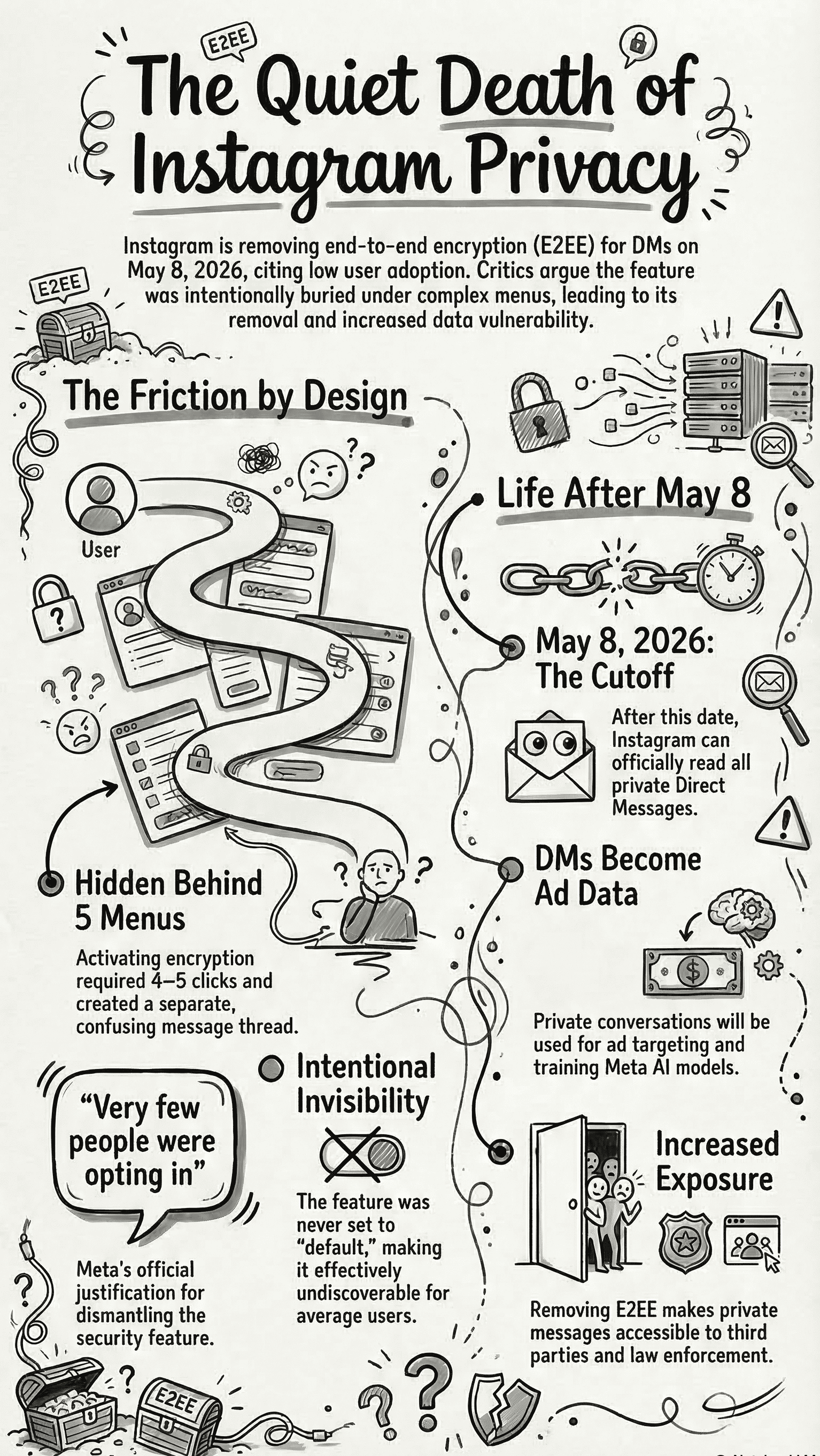
That feature is now gone. Starting May 8, 2026, Instagram will no longer support end-to-end encrypted direct messages. Users with existing encrypted chats are being asked to download their data before the deadline. After that, Meta makes no promises about what happens to it.
Meta's official reason: "Very few people were opting in."
Which is true. And also the point.
A Feature Built to Fail
End-to-end encryption on Instagram DMs was never on by default. It required 4-5 deliberate clicks to activate a single conversation. Not an account setting. A single conversation. It then created a completely separate thread from your existing chat with that person, meaning anyone you tried to message privately also had to navigate the confusion of two parallel conversations. It was available only in select regions. It never synced reliably across devices. There was no announcement, no onboarding, no nudge to try it.
WhatsApp, also owned by Meta, requires zero clicks. Encryption is simply on.
The same company built both. The difference in design was not accidental.
When a feature is buried deep enough that most users never discover it, never use it, and never miss it, the company that built it gets to cite low adoption as a neutral, data-driven reason to remove it. It is a clean way to take something away. It does not look like a decision. It looks like housekeeping.
What Zuckerberg Said
This is hard to square with the public record.
In 2019, Mark Zuckerberg wrote: "I believe the future of communication will increasingly shift to private, encrypted services where people can be confident what they say to each other stays secure. I understand that many people don't think Facebook can or would even want to build this kind of privacy-focused platform, but I want to be clear that this is the direction we are heading."
Meta spent the years that followed building toward that direction, at least visibly. WhatsApp was end-to-end encrypted by default. Messenger followed. Instagram DMs were rolled out with encryption in December 2023, framed as the completion of a years-long vision.
Two and a half years later, one of those three is being walked back.
The Backstory That Isn't About Adoption
What changed between 2019 and now is not user behavior. It is political pressure.
Internal documents surfaced during a lawsuit brought by New Mexico's attorney general reveal that Meta executives were debating as far back as 2019 whether end-to-end encryption would hamper their ability to detect child sexual abuse material on the platform. The lawsuit accused Meta of knowingly building systems that made its platforms less safe by limiting visibility into private messages. That tension, between user privacy and platform accountability, has only intensified since.
Governments have not been quiet. The EU is drafting what it calls a "Technology Roadmap" designed to give law enforcement lawful access to private messages on major platforms. US and UK regulators have applied similar pressure. The argument is always the same: encryption protects criminals as much as it protects ordinary users, and platforms need to be able to see what is happening in order to act.
It is a real argument. And it is being used, by governments and by companies, to justify the erosion of a protection that most people never think about until it is gone.
Privacy researchers push back hard. Their position is that weakening encryption does not protect children. It exposes everyone else. The mathematics of end-to-end encryption do not have a setting for good actors only. You either have it or you do not. Backdoors built for law enforcement are backdoors available to anyone who finds them.
As one cybersecurity researcher put it: "The only thing killing E2EE for general users will do is make them more vulnerable."
What This Actually Means
Here is what end-to-end encryption does in practice: only the two devices in a conversation can read the messages. The data is scrambled in transit and can only be unscrambled by the recipient's device. Not the platform. Not a hacker who intercepts the signal. Not a government agency with a legal order. When it is working, it is working completely.
After May 8, it is no longer working on Instagram.
Meta can read the content of every Instagram direct message. Those messages may influence the ads served to users. The company confirmed in December 2025 that interactions with Meta AI inside private conversations already feed ad targeting. They may be used to train AI models. They may be handed to third-party partners. They may be produced in legal proceedings.
| What Meta can now do | What this means for you |
|---|---|
| Read message content | Conversations are no longer private |
| Feed ad targeting | Your words become ad signals |
| Train AI models | Your messages become training data |
| Share with third parties | You have no visibility into who sees what |
| Produce in legal proceedings | Past messages carry new legal exposure |
Someone is messaging their therapist on Instagram right now. Someone is disclosing something they have not told anyone else. Someone is sending photographs they would never want stored on a server. Someone is having a conversation they believed was protected by the same mathematics that protects their banking transactions.
They do not know about May 8. They probably never knew the encrypted feature existed.
The Reminder This Carries
Privacy on third-party platforms has always been conditional. It exists as long as the company offering it decides it should. It can be removed in a policy update, buried in a terms of service change, or quietly deprecated under the cover of low adoption numbers. There is no contract. There is no lock. There is only the current version of the product and whatever the next version decides to keep.
This is not unique to Meta. It is true of every platform where communication happens at the discretion of a private company. The tools people use to speak privately are only as permanent as someone else's product roadmap.
What Instagram's encrypted DMs are leaving behind is not just a feature. It is a reminder worth writing down: the encryption you depend on today can disappear with a policy update you didn't agree to.
Her Instagram DMs have a new reader now. She did not ask for one.
None of us did.